Suspense fallback
Loading
Preparing pagePlease wait1%
CodeDesignShip
Preparing a focused brutalist interface for projects, skills, writing, and product work.
Suspense fallback
Freelance Development + 2026-06-08 + 11 min read
Compare freelance developers, agencies, and in-house teams for MVPs, SaaS products, AI tools, marketing sites, and long-term product development.
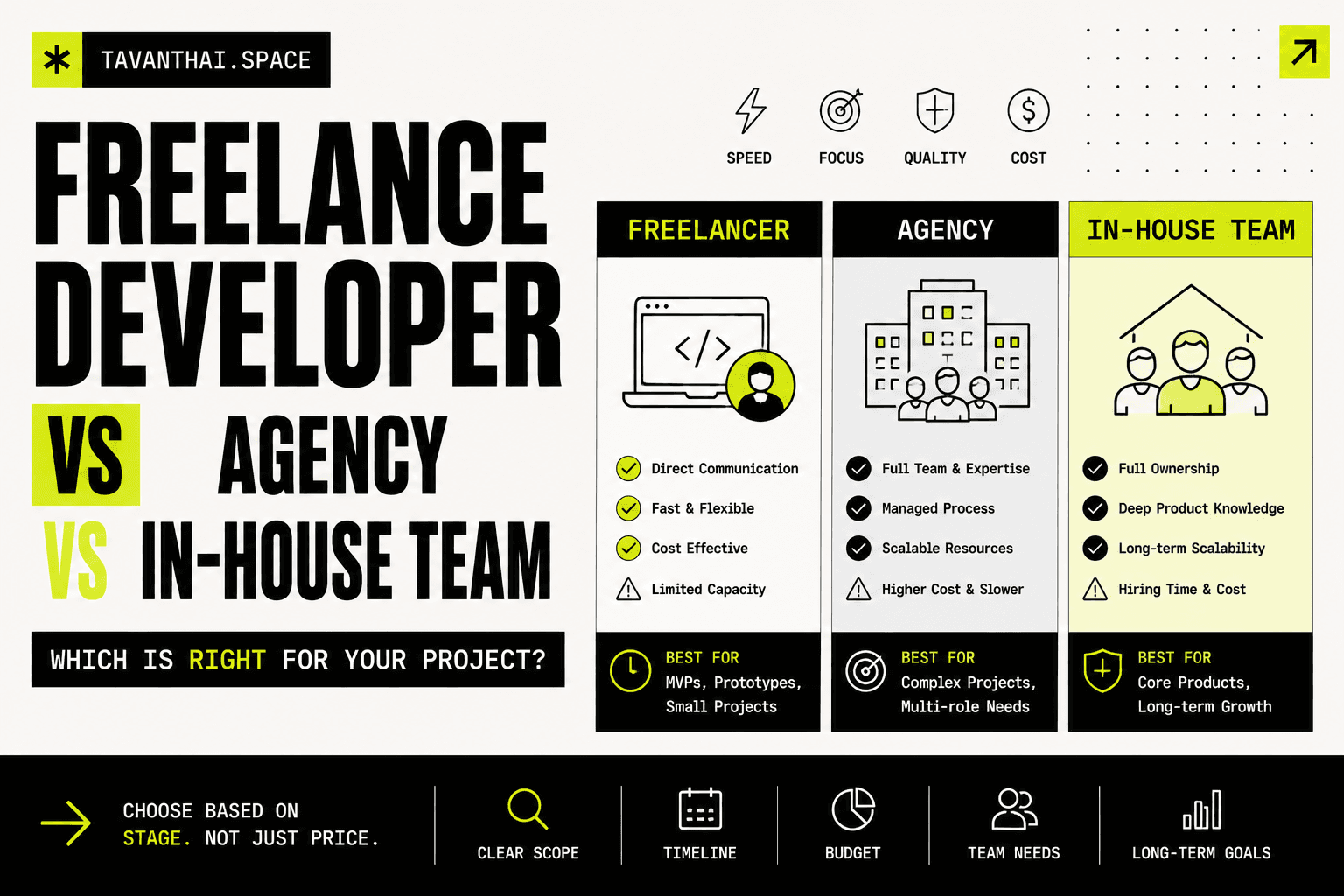
Business owners often ask the same question before building a web product: should I hire a freelancer, an agency, or an in-house developer? The answer depends on scope, budget, speed, risk, and how much product ownership you need after launch.
There is no universal best choice. A freelance developer can be perfect for a focused MVP, technical prototype, AI workflow, SaaS dashboard, or performance-focused website. An agency can be better for brand-heavy projects with design, content, QA, and multiple stakeholders. An in-house team becomes important when the product is already central to the business.
The mistake is choosing based only on price. The better approach is to choose based on stage.
A freelance full-stack developer is often the right choice when the project has a clear goal and a limited first version. This might include:
The advantage is direct communication. You talk to the person building the product. Decisions are faster. The scope can be adjusted quickly. The cost is usually lower than an agency because there are fewer layers.
The risk is capacity. One freelancer cannot be a full product team forever. If the project needs branding, UX research, content writing, QA, DevOps, and multiple integrations at the same time, one developer may not be enough.
An agency is useful when the project needs several roles: designer, developer, project manager, QA, copywriter, and strategist. Agencies can handle more coordination, which is useful for companies with larger budgets and multiple stakeholders.
The tradeoff is cost and speed. Agencies often require more meetings, documents, and process. That can be positive for larger companies, but it can slow down early MVPs that need fast learning.
If you hire an agency, ask who will actually build the product. The sales team may be excellent, but the implementation quality depends on the delivery team.
An in-house developer or team is the right choice when the product is not a one-time project. If software is the business, internal ownership matters. An in-house team understands users deeply, maintains long-term architecture, and responds to changing priorities.
The downside is hiring time and cost. Recruiting, onboarding, salaries, management, and retention are significant commitments. For an unvalidated idea, hiring in-house too early can create pressure before the business knows what it needs.
Many startups begin with a freelancer, then move to an agency or in-house team after validation. That path can work well if the freelancer builds clean foundations and documents decisions.
For a marketing site, a freelancer is often enough if the design is clear and the site needs performance, SEO, analytics, and CMS integration. An agency may be better if branding and copywriting are part of the scope.
For an MVP, a freelance full-stack developer is often the fastest path. The founder can work directly with the developer and keep scope lean.
For an AI product, a freelancer can build a strong prototype if they understand AI APIs, retrieval, cost, and UX. An agency may be better if the product needs research, compliance, and multiple engineering specialists.
For a mature SaaS product, an in-house team is usually better because the codebase needs ongoing ownership.
Ask yourself:
If the project is still being validated, hire for learning speed. If the project is already validated, hire for long-term ownership.
Freelancers, agencies, and in-house teams solve different problems. A freelance developer is best for focused, fast, high-leverage builds. An agency is best for coordinated multi-role delivery. An in-house team is best for long-term product ownership.
If you are building an MVP, AI tool, content platform, or SEO-ready web product, a freelance full-stack developer can be the right first step. The key is clear scope, honest communication, and a development process that turns business goals into working software.
Usually yes, but cost should not be the only factor. The right choice depends on scope, complexity, and support needs.
Hire an agency when the project needs multiple roles, structured delivery, QA, branding, content, and ongoing support.
Build in-house when software is central to the business and the product needs continuous long-term development.
Have an idea or project?
Let's build something amazing.アイデアやプロジェクトがありますか?素晴らしいものを一緒に作りましょう。