Suspense fallback
Loading
Preparing pagePlease wait1%
CodeDesignShip
Preparing a focused brutalist interface for projects, skills, writing, and product work.
Suspense fallback
Freelance Development + 2026-06-13 + 9 min read
A client-friendly guide to hiring a remote Next.js developer for small bug fixes, production issues, authentication problems, broken forms, layout bugs, and deployment errors.
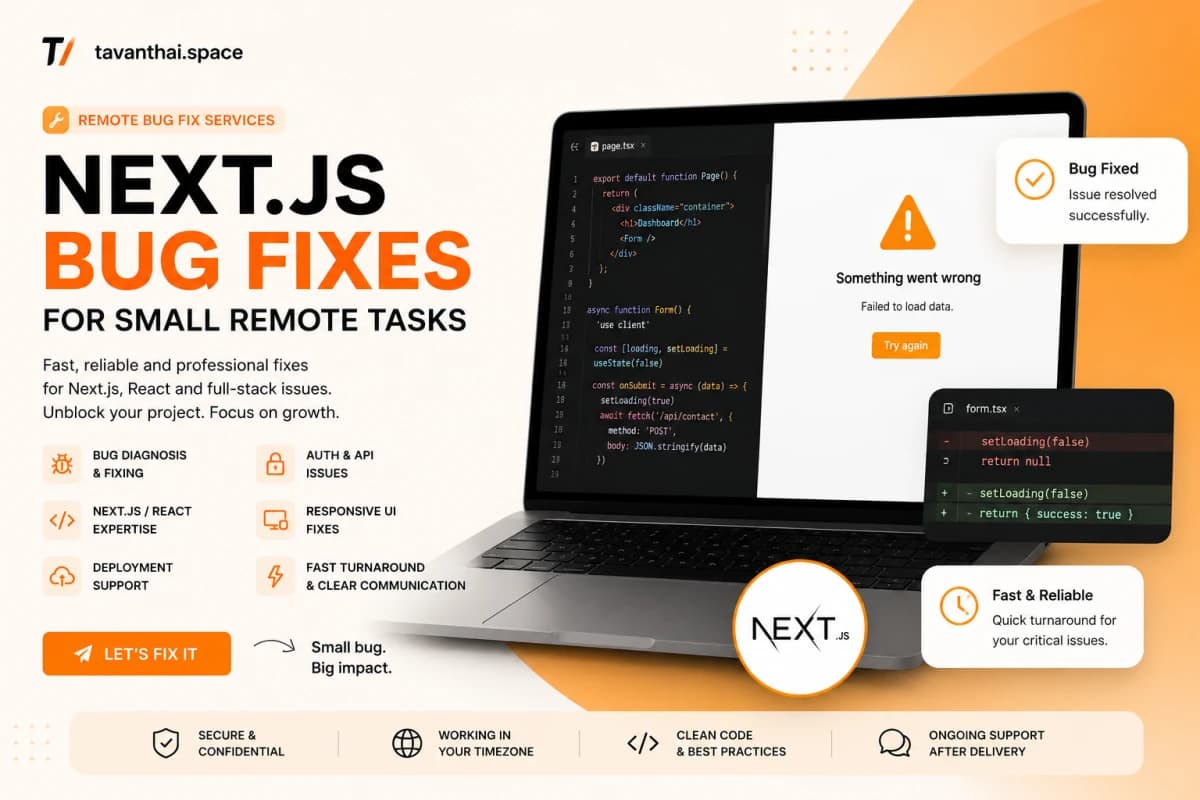
Small bugs can create big problems. A broken form can stop leads. A failed deployment can delay a launch. A layout issue can make a business look less professional. An authentication bug can block users from accessing the product.
For many of these issues, hiring a remote Next.js developer for a small focused task is enough. You may not need a full redesign, a long contract, or a new engineering team. You need someone who can understand the bug, reproduce it, find the cause, fix it, test it, and explain what changed.
Remote job pages and freelance marketplaces often include small tasks for React and Next.js developers, including production fixes, frontend bugs, API issues, and authentication problems. That demand exists because businesses often need immediate technical help for one specific blocker.
Next.js projects can fail in different places: routing, server rendering, client components, API routes, deployment, environment variables, or third-party integrations.
Common small tasks include:
The visible bug may be small, but the cause can be hidden. That is why good context is important.
The fastest bug fix starts with clear information. Before contacting a developer, prepare:
If the bug involves private data, share only what is necessary. A developer can often diagnose the issue using test accounts, screenshots, logs, and limited access.
"It does not work" is hard to debug. "Open this page, click this button, submit this form, then the success message never appears" is much easier.
Good reproduction steps help the developer:
If the issue happens only sometimes, mention that too. Intermittent bugs may involve caching, race conditions, authentication expiry, network timing, or deployment differences.
Hourly work is usually better when the cause is unknown. A bug may look like a frontend issue but actually come from an API, environment variable, database permission, or hosting configuration.
Fixed price can work when:
For unclear bugs, a good first step is a short diagnostic task. The developer investigates, explains the cause, and estimates the fix.
A professional bug fix should include more than changing code quickly.
The developer should:
This matters because rushed fixes can create new problems. A small task still deserves careful delivery.
Here are examples of small remote tasks that can be handled efficiently:
Each task is small, but each one can remove a real business blocker.
After a bug fix, the client should receive a short summary:
This handoff helps the client understand the work and makes future maintenance easier.
Hiring a remote Next.js developer for a small bug fix can be a practical way to unblock a website or product. The key is clear context: URL, reproduction steps, screenshots, logs, and expected behavior.
If you have a Next.js or React issue that is affecting users, leads, deployment, or launch, a focused remote task may be enough to fix it.
Yes. Many Next.js bugs can be fixed remotely when the client provides the repository, reproduction steps, screenshots, production URL, and expected behavior.
Useful information includes the exact error, steps to reproduce it, affected URL, recent changes, screenshots, logs, environment details, and what the correct behavior should be.
Hourly work is usually better for unclear bugs that require investigation. Fixed price can work when the issue is well defined and easy to reproduce.
Have an idea or project?
Let's build something amazing.アイデアやプロジェクトがありますか?素晴らしいものを一緒に作りましょう。