Suspense fallback
Loading
Preparing pagePlease wait1%
CodeDesignShip
Preparing a focused brutalist interface for projects, skills, writing, and product work.
Suspense fallback
Web Performance + 2026-06-08 + 10 min read
A practical overview of website performance and technical SEO fixes that a remote freelance developer can deliver for business websites and Next.js applications.
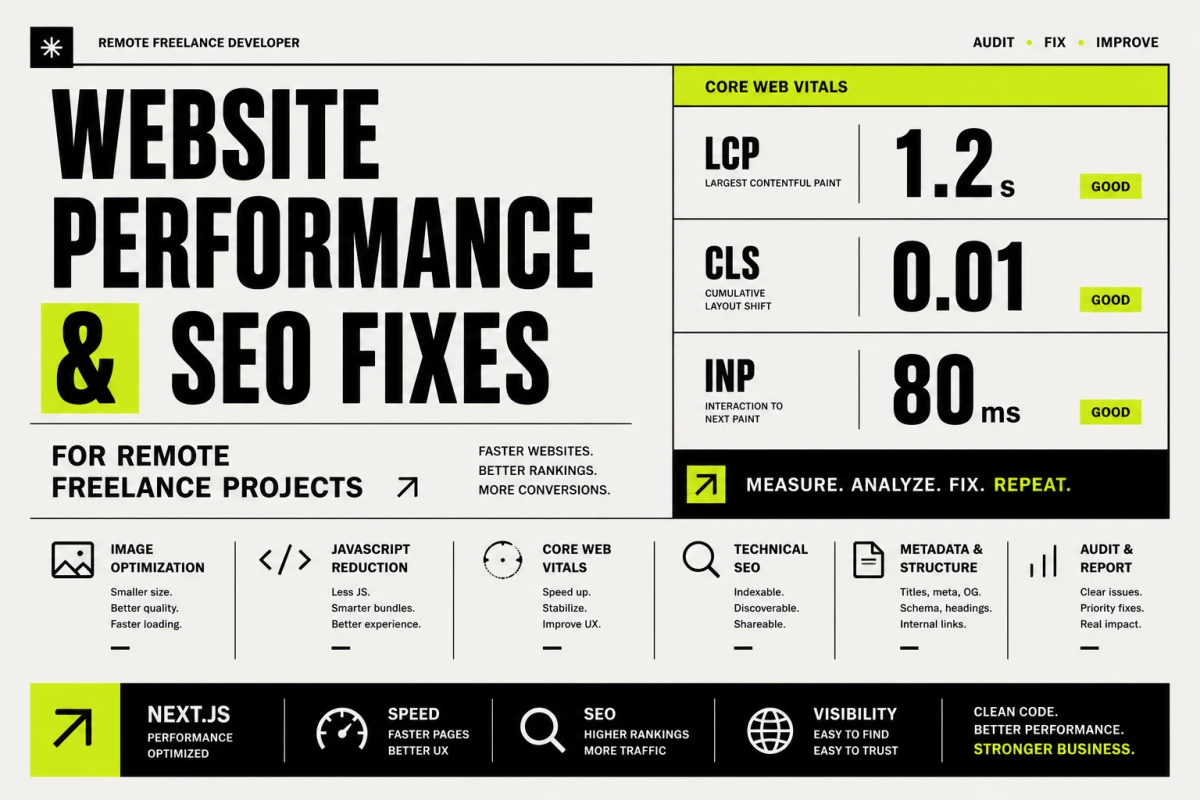
Performance and SEO are closely connected. A website that loads slowly, shifts layout, hides important content, or lacks metadata creates friction for both users and search engines. For business websites, portfolios, SaaS landing pages, and content platforms, these issues can reduce trust and lower conversions.
A remote freelance developer can often improve performance and technical SEO through a focused audit and implementation task. The goal is not to chase perfect scores. The goal is to make the website faster, clearer, and easier to discover.
Many websites become slow because of small decisions that add up over time.
Common issues include:
In a Next.js project, performance work often starts with understanding which parts of the page need interactivity and which parts can stay server-rendered.
Images are often the largest assets on a page. A performance task may include resizing images, using modern formats, setting correct dimensions, and using the Next.js Image component correctly.
Good image handling improves:
For product and portfolio websites, images should be sharp enough to build trust but not so heavy that they slow the page.
React and Next.js applications can accidentally ship too much JavaScript to the browser. This happens when entire sections become client components, large libraries are loaded for small interactions, or pages rely on unnecessary client-side state.
A developer can review:
Reducing JavaScript can improve responsiveness and make the site feel faster on lower-powered devices.
Core Web Vitals are useful because they connect performance to real user experience. The most common areas to review are loading speed, interaction responsiveness, and visual stability.
Practical fixes may include:
The best fixes are usually simple and measurable.
Technical SEO helps search engines understand and index a website correctly. It also improves how pages appear when shared on social platforms.
For a Next.js site, useful SEO work can include:
These fixes are especially useful for blogs, service pages, portfolios, case studies, and landing pages.
A practical performance and SEO audit should not be a long vague report. It should identify issues, explain business impact, and recommend changes in priority order.
A good audit includes:
After the audit, the highest-impact fixes can be implemented as a small remote project.
Small businesses often depend on trust. If a website loads slowly, looks broken on mobile, or shares poorly on social media, visitors may assume the business is less reliable than it is.
Performance and SEO fixes help the site feel more professional. They also create a better foundation for future content, ads, analytics, and conversion work.
Website performance and technical SEO are practical areas for remote freelance work. A developer can inspect a site, identify high-impact problems, implement targeted fixes, and document what changed.
For Next.js websites, the best improvements often come from image optimization, JavaScript reduction, stable layouts, metadata cleanup, sitemap and robots setup, and clear page structure.
A remote developer can optimize images, reduce unnecessary JavaScript, improve rendering strategy, fix layout shifts, audit third-party scripts, improve caching, and review Core Web Vitals.
Useful technical SEO fixes include metadata, canonical URLs, sitemap, robots rules, structured data, Open Graph images, heading structure, internal links, and indexability checks.
No technical fix can guarantee traffic, but better performance and technical SEO make a website easier for users and search engines to access, understand, and trust.
Have an idea or project?
Let's build something amazing.アイデアやプロジェクトがありますか?素晴らしいものを一緒に作りましょう。